Always Somewhere Else

Here goes Mateo, like every Sunday of his adult life, spiralling into his own world before the week even starts.
He is the kind of person who lives in the future, before it even lands in the present.
Today he is already stressed about the house he promised himself, and the children he will one day have. Bear in mind, he doesn't even have a girlfriend yet.
He picks up his phone to switch off. Boredom wins quickly. He puts on the show his friend Nick had been recommending for weeks. The main character has it all — the house, the wife, the dream job, the children. And yet, he is miserable. Mateo shakes his head.
"Ungrateful," he mutters to himself. "If I had that life, I would never complain about a single thing." And just like that, without even noticing, he is back in his own spiral.
He turns off the TV and decides to cook instead. Eggs, rice, vegetables. Simple enough.
But somewhere between chopping and stirring, he remembers that all his work shirts are still in the basket. He runs to put a wash on, and by the time he comes back to the stove, the food is burnt.
"EVERYTHING IS WRONG. WHY CAN'T EVEN THE SIMPLE THINGS GO RIGHT?"
His phone buzzes. A message from Nick: "You coming? It starts in an hour."
The TED talk. He had completely forgotten about it. One more thing he didn't want to do, on a day that was already going sideways. But Nick was expecting him, and Mateo was not the kind of person to let someone down, even when he was falling apart himself. He grabbed his keys and went.
Mateo arrived at the venue and Nick was, of course, nowhere to be found. He sent a message and stood near the entrance, arms crossed, irritated at everything and nothing in particular. That was when a man approached him, holding out a set of keys.
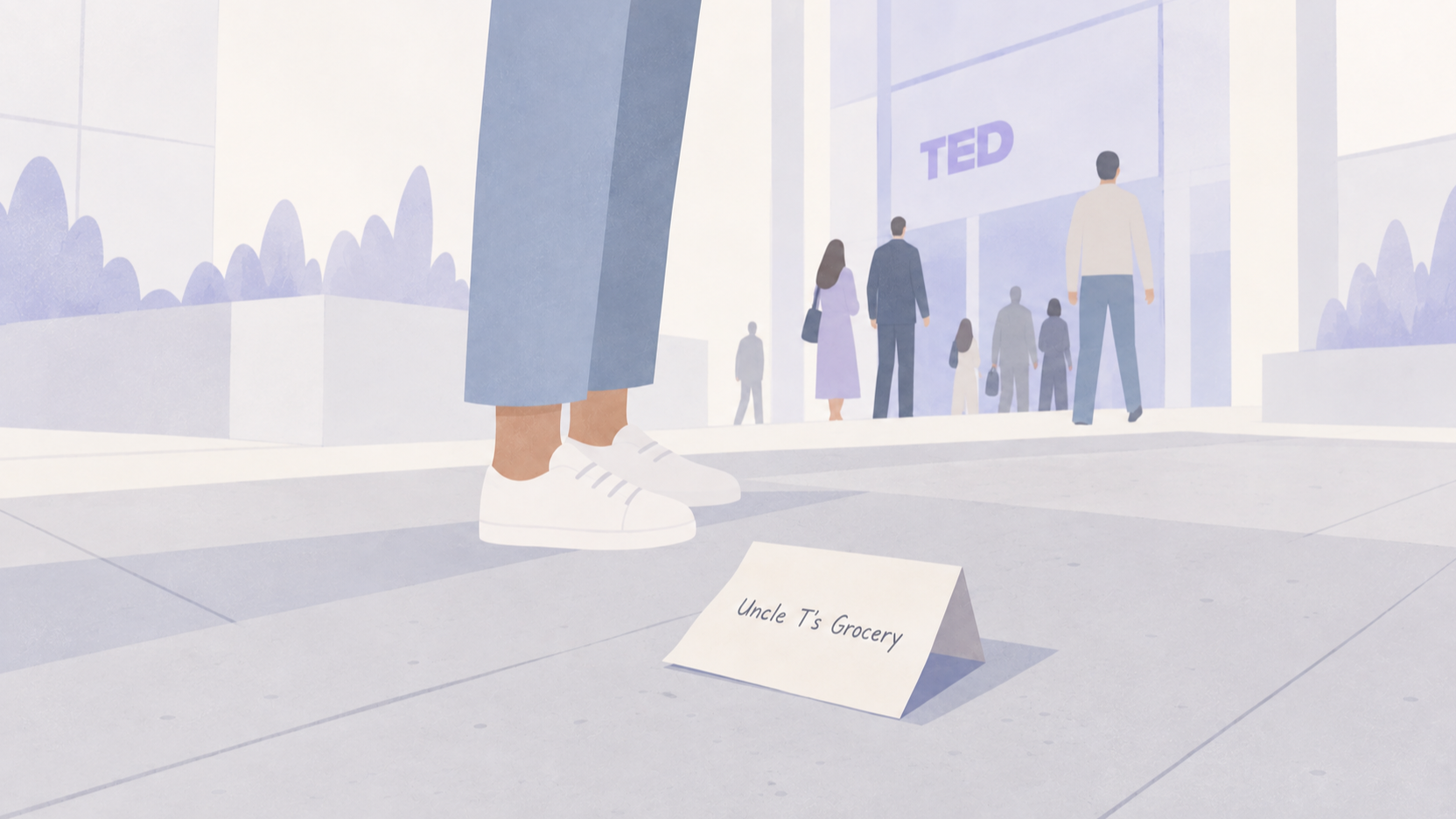
"Excuse me, are these yours? They were on the floor."
Mateo looked down. His keys. He must have dropped them on the way in. "Thanks," he said, taking them back without looking up. Flat, distracted, don't talk to me.
But the man didn't leave. He just stood there and smiled.
"Can I help you with something?" Mateo asked, with the tone of someone who very much hoped the answer was no.
"Young man," the stranger said warmly, "when was the last time a thank you actually meant something to you?"
Mateo stared at him. "I'm sorry, who asked for your opinion? Mind your own business.”
"I understand," the man replied, as calm as if Mateo had just said good morning. "You have a lot of anger inside of you. And that anger is just the anxiety speaking. I can see it. I can feel it."
"You don't know me," Mateo shot back. "You exchanged two words with me and now you think you know what I feel? You're delusional."
"You're right," the man said, without any defensiveness at all. "I don't know you. But I can see through you. I recognise what you carry because I carried it too, for many years."
He paused and looked at Mateo steadily. "So let me just ask you one thing. Do you honestly believe that by worrying this much, you will get where you want faster?"
Mateo opened his mouth, then closed it again.
"You won't," the man said gently. "You will just get there more painfully."
He smiled one last time, and then he was gone, disappearing into the crowd as quietly as he had appeared.
Seconds later, Nick arrived, out of breath and mid-apology before he even reached Mateo. Traffic, the cab, so sorry, shall we go in? Mateo nodded slowly, looking like a man who had just seen a ghost.
They walked in together, and as they did, Mateo glanced down at the floor. A small folded piece of paper. He picked it up and read:
"Nobody has all the answers. But walk as if things will work out. Because they will. And that certainty alone will make everything lighter."
Two days passed. Mateo read the note so many times that the fold started to wear thin. He didn't fully understand it yet, but he knew that something had shifted inside of him, and he knew where to find the man who had shifted it.
Maybe he was crazy for going back. He went anyway.
The shop was small and quiet, exactly the kind of place you walk past a hundred times without noticing. The man was there, arranging things behind the counter. He looked up and smiled, the same smile as before.
"Well, hello there. What are you looking for today?"
Mateo knew he wasn't talking about anything on the shelves. He stood there for what felt like a long time, searching for the right words. Then he took a breath and spoke.
"I am tired," he said. "I have been tired for as long as I can remember. I keep spiralling into the same thoughts, the same pressure, the same anxiety. And you saw all of that in two minutes. I don't even fully know why I came back here, but I think I just needed someone to talk to." He paused. "I want to ask you something. How?"
The man looked at him kindly. "How what, son?"

"How did you change your life?"
The man was quiet for a moment before answering. "My life is still pretty much what it was," he said. "Except I have changed. Life will always be life. It will always have its ups and downs, and there is nothing we can do about that. But the way I look at things now is different. I have come to understand that there is joy in every little thing, even in a conversation like this one." He smiled softly. "I couldn't see that before. I was too busy living in the future, always chasing something just out of reach, convinced that when I finally got there, I would be happy. But that is just an illusion. Because the truth is, we can decide to be happy right here, right now, if we are willing to look at all that life is already giving us."
Mateo sat with those words for a long time.
And then, without saying anything else, he pulled up a chair and stayed.